What a grad scheme interview actually looks like in 2026
For most large UK grad schemes (banking, consulting, Big 4, FMCG, tech, retail, public sector), the application funnel in 2026 looks roughly like this:
Online application form (work history, education, motivation questions, sometimes the dreaded "Why this firm?" essay)
Online aptitude tests (numerical, verbal, situational judgement, sometimes game-based assessments)
AI or conversational interview (recorded video or text, usually 20–40 minutes, scored against role competencies)
Assessment centre (case study, group exercise, presentation, partner / hiring-manager interview)
Offer
The AI interview is the stage that filters the most candidates per minute of recruiter time. It's where most grad schemes do their second big cut after the aptitude tests. If you don't pass it, you don't get an assessment centre invitation and you don't get a recruiter conversation.
This post is about that third stage specifically.
Which grad schemes use AI interviews
HireVue is the most commonly cited AI interview platform on UK grad schemes. It's particularly entrenched in investment banking - JPMorgan, Goldman Sachs, Morgan Stanley and BlackRock are well-documented HireVue users in their early careers processes. Several large consultancies, Big 4 and large corporates also use one-way video or conversational AI at the first-round stage, though firms rotate between assessment platforms (HireVue, Sova, Arctic Shores, Pymetrics, AON cut-e, Cappfinity and others) and a single firm's platform can change year to year. Don't assume - check the specific firm's current process on their careers page, on recent Glassdoor write-ups, or on Reddit r/UKJobs / r/Big4 before you prepare.
HireVue dropped facial analysis in 2021 and now scores transcripts only.
Sapia runs blind, text-based chat interviews scored against role-specific rubrics, used by various large employers in retail and high-volume hiring. Paradox (the Olivia chatbot) runs conversational text-based screening, widely used in high-volume hourly and retail recruitment. Both score what you type, not how you look or sound.
If you're applying to a grad scheme and you've already done the online tests, assume there's an AI interview between you and the assessment centre. Check the firm's careers page and any recent applicant write-ups on Glassdoor / The Student Room / Reddit r/UKJobs for confirmation.
The 4 competencies grad schemes weight hardest
Grad scheme AI interviews are scored against role-specific competencies, but four show up across almost every UK grad scheme:
1. Commercial awareness
Do you understand how this firm makes money, who its clients are, what's changing in the industry, and why that matters for the role you've applied for? Grad schemes weight this heavily because it separates "I want a job" candidates from "I want this job" candidates.
2. Teamwork and collaboration
Can you work effectively with other people, especially people who disagree with you, especially under deadline pressure? Grad schemes lean on this because grad work is collaborative by default and they're scoring whether you'll function inside a team of five other grads.
3. Problem-solving
When something doesn't work the way you expected, what do you actually do? Grad schemes are looking for structured thinking, not perfect answers. Show your reasoning.
4. Leadership and initiative
Leadership at grad-scheme level rarely means "I led a team of 30." It usually means "I noticed something that wasn't working and I did something about it." Initiative is the strongest signal at this career stage.
Build your story bank around these four. Six stories, each one tagged to one or two competencies, will cover the vast majority of questions you'll see.
The "Why this firm?" question (the one grad schemes weight heaviest)
If there's one question that gets weighted harder than anything else at the AI interview stage of a grad scheme, it's some version of "Why this firm?"
"Why our firm?", "Why this scheme over our competitors?", "What attracted you to apply to us specifically?", "What do you know about us?" - all the same question.
Grad schemes weight this heavily because:
Generic answers are extremely common ("I admire your culture", "You're a leader in the industry", "My values align with yours"). They filter very fast.
A specific, evidenced answer is rare. It's also the strongest signal that this candidate did their homework and isn't just spraying applications.
What a generic answer looks like:
"I'm really drawn to your firm because of your strong reputation in the industry and your commitment to developing graduates. Your culture of excellence aligns with my own values, and I'd love to be part of a team that's making a difference."
This answer could be pasted into any application. The AI is scoring whether the words you used could only be true of this firm, and these words could be true of literally any large firm.
What a specific, evidenced answer looks like (this is a template - swap in your own firm research, the bracketed bits are placeholders):
"Three things specifically. First, your firm's restructuring practice has done the lead advisory work on the last three large UK retail restructurings - I've been following the [specific recent deal] and the angle your team took on operational vs. financial restructuring is the kind of work I want to do. Second, the grad rotation I read about lets you spend six months in your Frankfurt office, which matters because I want to build cross-border experience early. Third, I spoke to [name] in your London office at the Spring Insight Week, and the way she described the partner mentorship structure was the most concrete answer I got from any firm I researched."
Three specific reasons. At least one of them references a firm-specific fact the candidate could only know if they'd actually researched the firm. The AI can score that.
Build this answer for every firm you apply to. Don't recycle. Recruiters and the AI both spot a recycled answer.
The 8-week grad scheme prep plan
This assumes you're applying to multiple grad schemes with rolling deadlines and you have roughly eight weeks to prepare properly. If you have less time, see the next section.
Week 1: Map the landscape
List every grad scheme you're applying to. For each one: deadline, stages, AI interview platform (where known), what they actually do.
For your top 3 priority firms, spend two hours each on commercial research. Recent deals, recent news, who their main competitors are, what's changing in their industry.
Weeks 2–3: Build your 6-story bank
Six stories from the last 18–24 months. Aim for variety: at least one academic, one work experience, one extracurricular, one with a difficulty / setback.
Tag each story to the 4 competencies. A strong story often hits two.
More on building a story bank, and the wider prep plan, is in How to Prepare for an AI Interview.
Weeks 4–5: Write each story in STAR
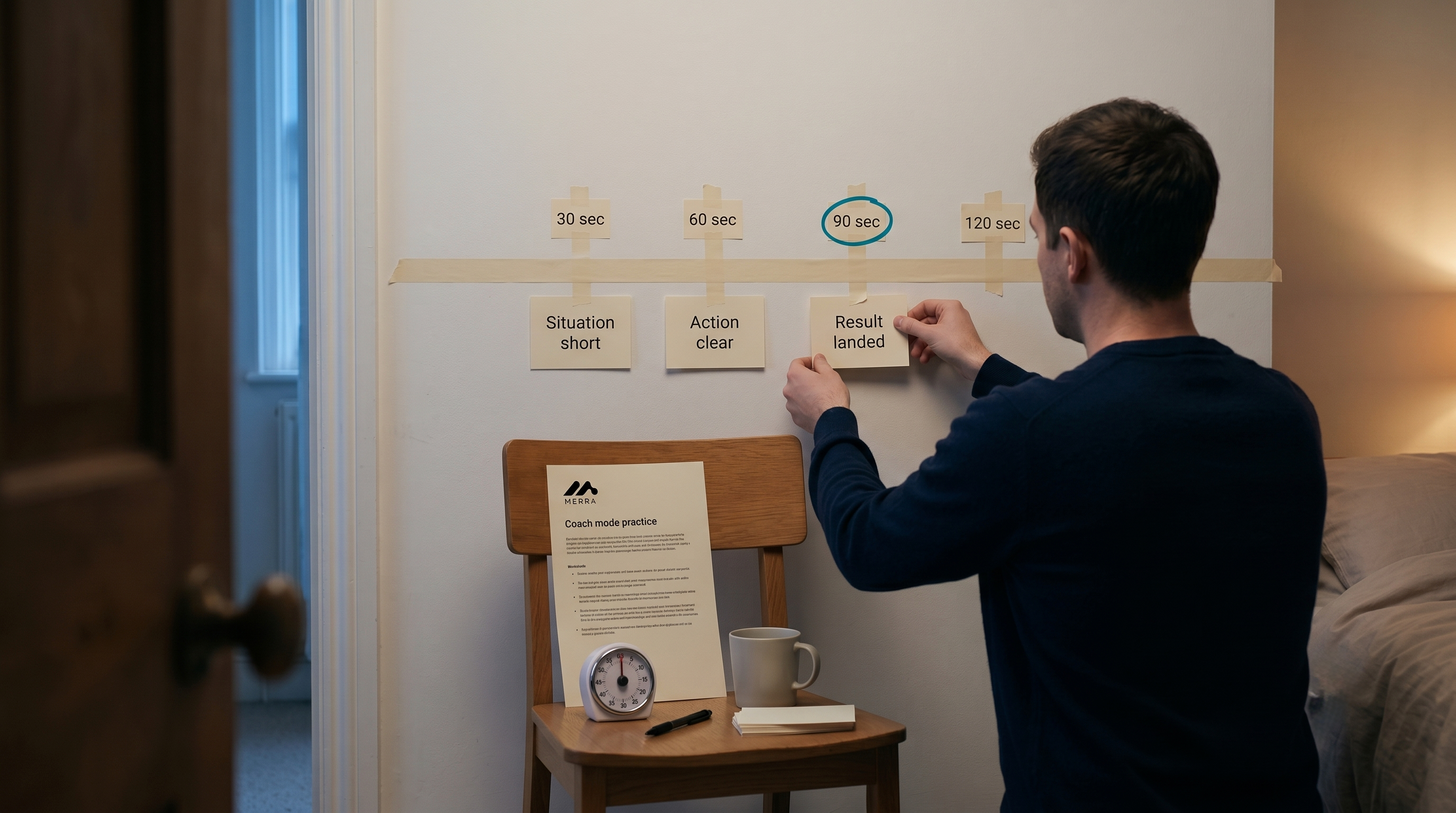
Use the STAR method for each story. 10% Situation, 20% Task, 60% Action, 10% Result. Action is the longest part by far.
Write each story down. Read it out loud. Time it. Aim for around 2 minutes per answer.
Week 6: Build a specific "Why this firm?" answer for every firm
Three specific reasons per firm. At least one firm-specific fact in each.
Don't recycle between firms.
Week 7: Coach mode practice
Run your top firms through a graduate-specific mock interview in Coach mode on Merra Practice. Coach mode gives you feedback after each answer and lets you tighten the structure before moving on.
Run through the 10 most common AI interview questions until you can answer each one in STAR without notes.
Week 8: Interview mode under pressure
Switch to Interview mode on Merra Practice. Straight questions, real follow-ups, no resets. This is where you find out which of your stories actually hold up under pressure.
For top firms specifically, also self-record yourself on Zoom or QuickTime answering 2–3 questions cold. The webcam-and-timer setup is what HireVue feels like.
Detailed walkthrough of the one-way video format is in HireVue Practice: What to Expect and How to Prepare for Free.
If you've only got a week or two
If your deadline is in 14 days, you can't do the full 8-week plan. Compress it:
Days 1–2: Pick your priority 2–3 firms. Do commercial research on each. Build the "Why this firm?" answer for each one.
Days 3–5: Build a 6-story bank in STAR. 90 minutes per story is enough at this stage.
Days 6–7: Run through the 10 most common questions in Coach mode on Merra Practice. Tighten everything.
Days 8–10: Run full mock interviews in Interview mode for each priority firm. Get follow-up questions. Adjust the weak stories.
Days 11–12: Self-record yourself on a webcam answering 3 questions cold. Watch the recording back at 1x. Fix the obvious tells (eye drift, fillers, rushing the result).
Days 13–14: Light practice only. Sleep. Don't try to learn anything new in the last 48 hours.
The 5 grad scheme AI interview mistakes that quietly kill applications
1. Generic "Why this firm?" answers
Covered above. Most common reason strong candidates get rejected at the AI round.
2. Stories from before university
The AI is scoring evidence of recent competency. Stories from school often read as stale even if the underlying example is strong. Pick from the last 18–24 months where possible.
3. Wall-to-wall "we"
If the answer is "we did this, we did that" throughout, the reviewer can't tell what you did. Attribute your specific contribution. See the STAR method post for the fix.
4. No commercial awareness
If you can't name a recent thing the firm has done, you almost certainly fail the "Why this firm?" and the commercial awareness questions. Pick three recent items per firm. Read the firm's own news / press release page, not just the summary on a careers blog.
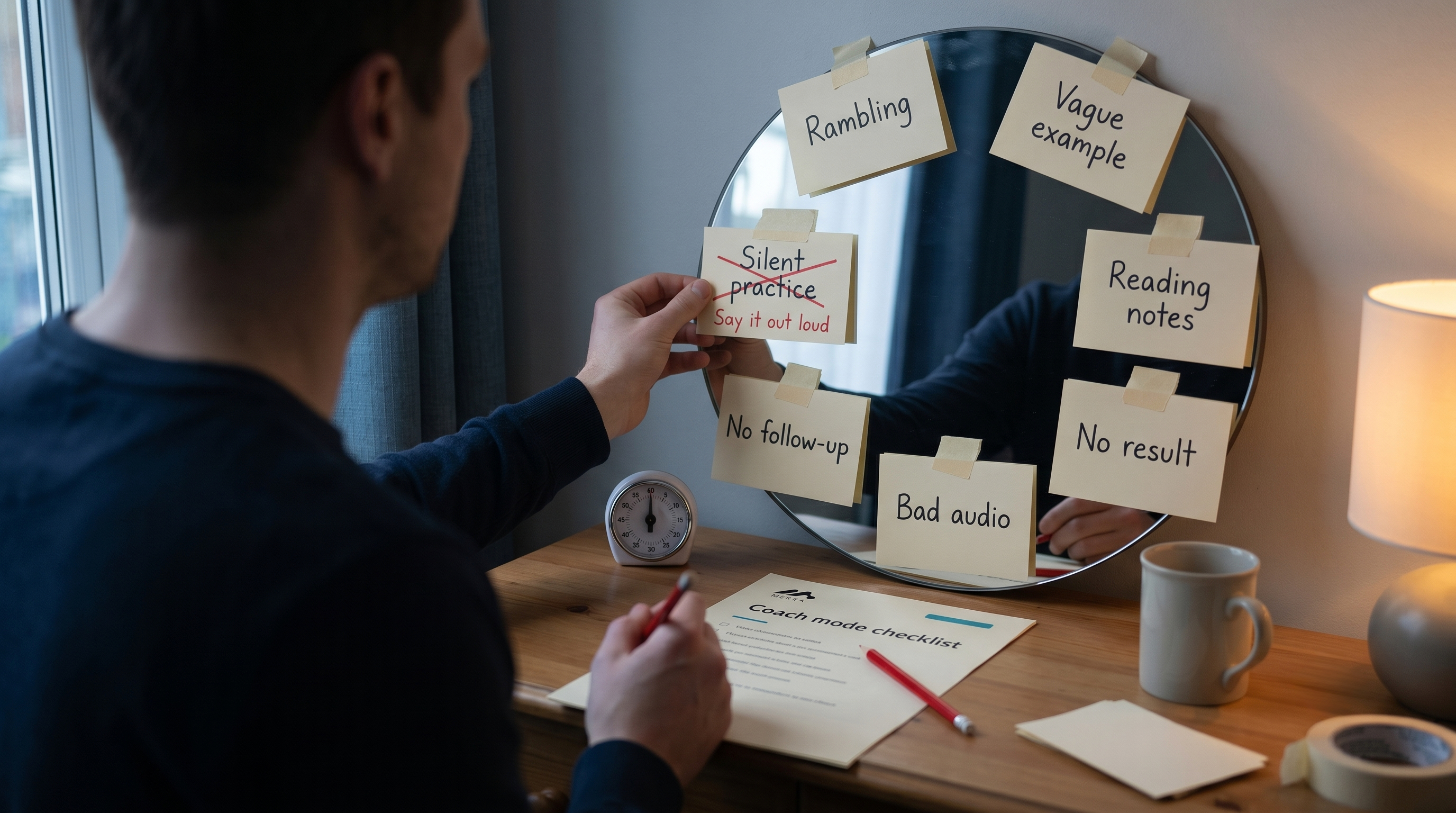
5. Practising silently in your head
Reading your stories isn't the same as saying them out loud against real follow-ups. The AI is scoring the transcript of what you actually said, not the perfect version you rehearsed silently. Practise out loud against an interview that pushes back.
Run the practice
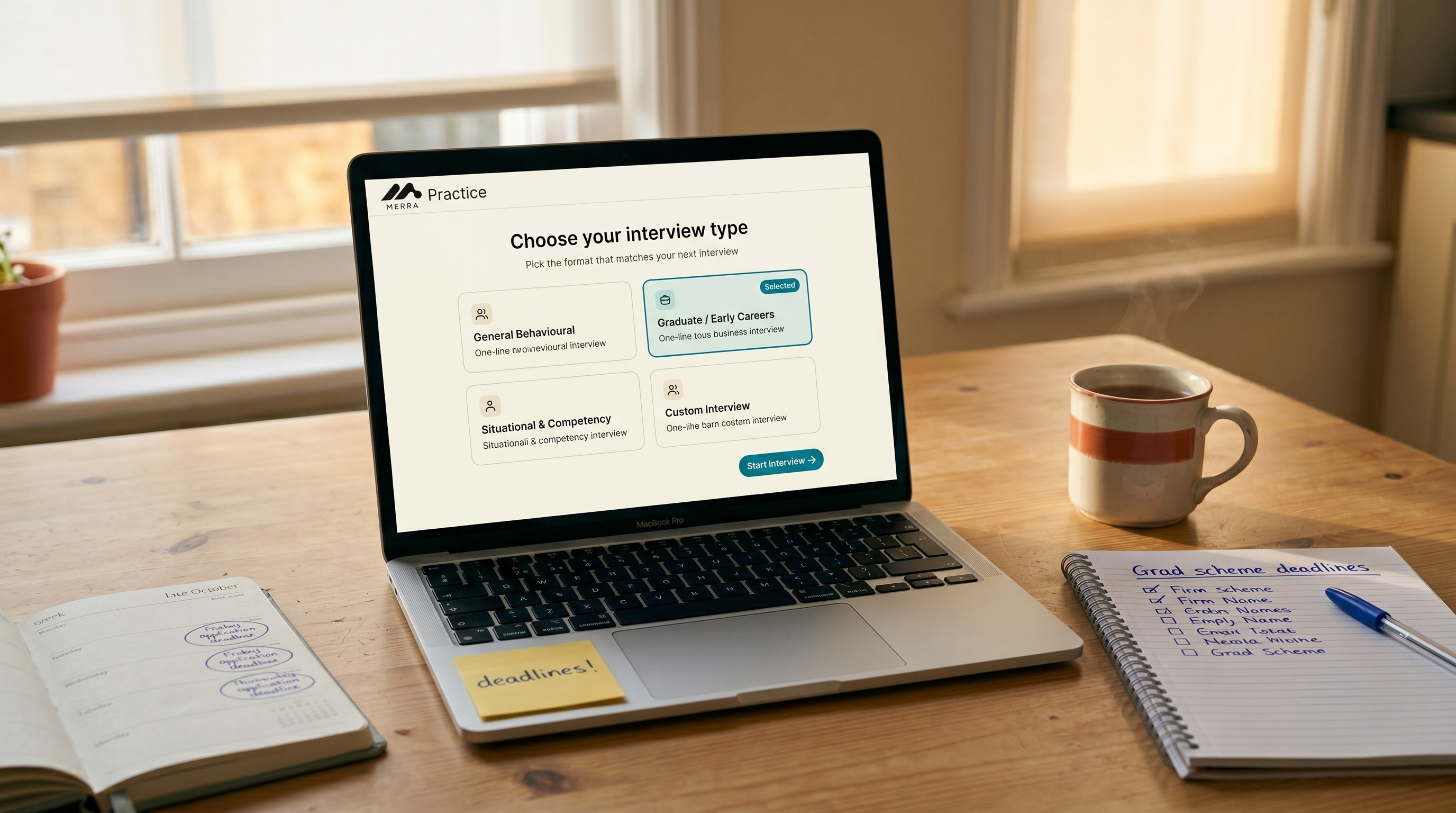
Merra Practice has a Graduate / Early Careers interview type built specifically for this. Free, no signup wall, and you can switch between Coach mode (real-time feedback after each answer) and Interview mode (straight questions, real follow-ups, no resets) when Merra asks at the start of the session.
If you've got a specific firm lined up, Custom Interview lets you paste in the job description and add up to five questions you want covered. The Top Company Prep tiles also cover Amazon, Google, Microsoft, Deloitte, PwC, KPMG, NVIDIA, GoTo, Shopee and Frontex with role-specific practice interviews.
🎯 Run a free graduate AI practice interview on Merra Practice and get feedback before the real one counts.
Ahmed Ghelle is the founder of Merra, an AI interviewing platform that runs structured first-round interviews on every applicant and produces a recording, transcript, and scored evaluation for each one. He writes about hiring, evidence, and the difference between speed and signal.