Interview tips for 2026
The best interview tips are still simple: understand the role, prepare real examples, practise speaking out loud, answer the question directly, and show the interviewer what it would feel like to work with you.
Most interviews in 2026 are not fully AI-led. Candidates still face recruiter phone screens, Zoom calls, in-person interviews, panel interviews, assessment centres and final conversations with hiring managers. The format changes, but the core skill is the same: can you explain your experience clearly under pressure?
This guide is a practical interview prep checklist for students, graduates and early-career candidates who want to make a strong impression in any interview format.
1. Start with the job description, not generic questions
Most candidates start by searching common interview questions. That is useful, but it should not be step one.
Start with the job description. Highlight:
The main responsibilities
The skills repeated more than once
The behaviours they mention, such as ownership, communication or teamwork
The tools, sectors or customers named in the role
Any values or working style clues
Then turn those into likely interview questions.
If the job description says you will work with clients, expect questions about communication and difficult stakeholders. If it says fast-paced environment, expect questions about deadlines and pressure. If it says analytical, expect questions about data, decisions or problem-solving.
The job description is the mark scheme hiding in plain sight.
2. Build a 7-story bank
You do not need a new answer for every question. You need a small set of strong stories you can adapt.
Prepare one story for each of these:
Teamwork
Problem-solving
Leadership or ownership
Conflict or disagreement
Failure or feedback
Working under pressure
Learning something quickly
Each story should have:
A clear situation
Your specific role
The action you personally took
A result
A short reflection
The key phrase is personally took. Interviewers are not just asking what happened. They are asking what you did.
A weak story says:
We worked together and managed to complete the project.
A strong story says:
I noticed we were duplicating work, so I created a shared task list, split the project into owners, and set a 15 minute check-in every morning. We finished two days early and avoided the last-minute panic we had in the previous project.
That is the level of detail you want.
3. Use STAR, but do not sound robotic
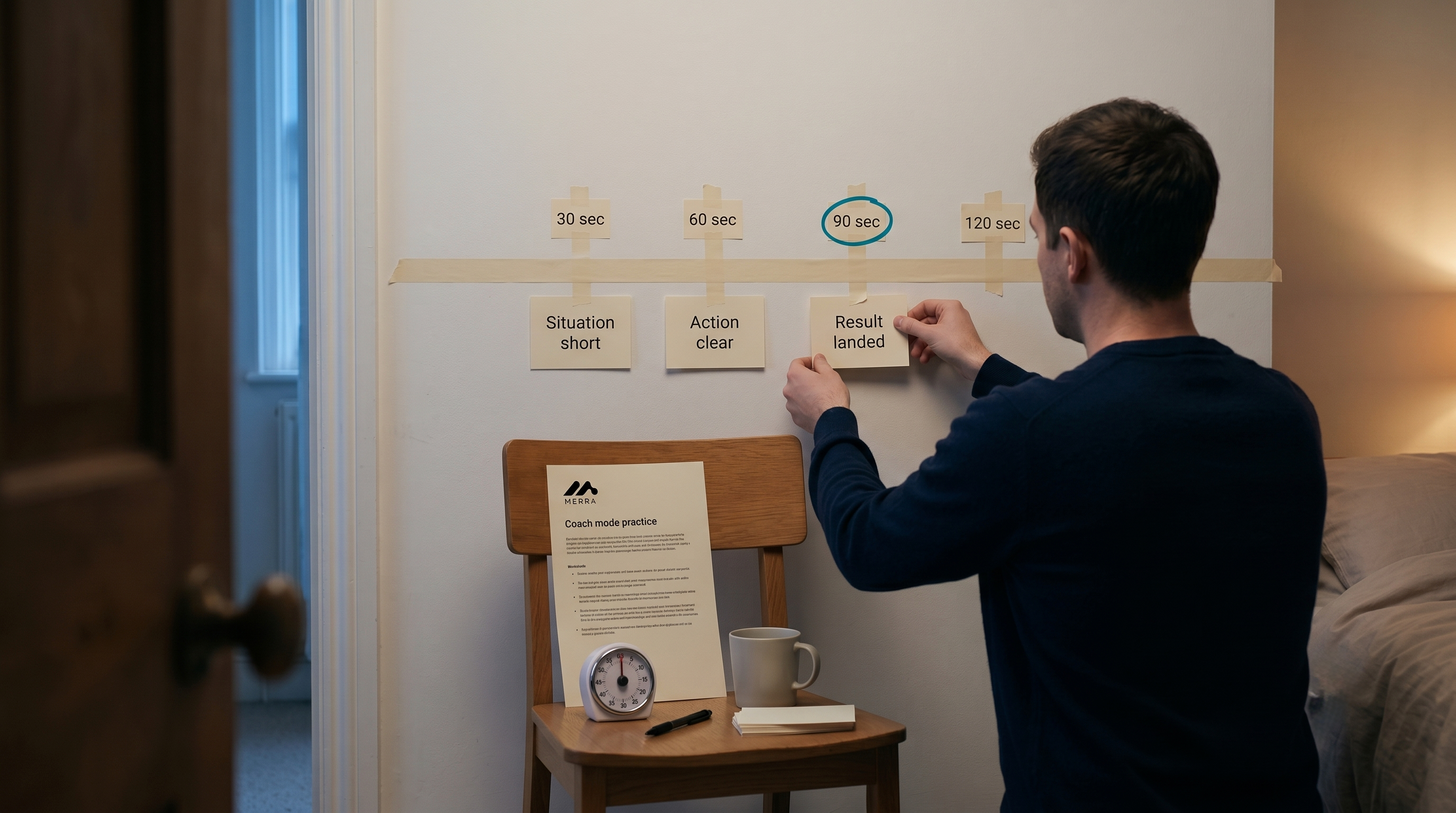
STAR stands for Situation, Task, Action, Result. It is useful because it stops you rambling.
But a lot of candidates use STAR badly. They spend too long on the Situation and Task, then rush the Action and Result.
Use this split:
Situation: 10 to 15 seconds
Task: 5 to 10 seconds
Action: 40 to 60 seconds
Result: 10 to 20 seconds
For most behavioural questions, your answer should sit around 60 to 90 seconds. Longer answers are fine when the question is deeper, but do not fill time just because you can.
The interviewer cares most about the Action. That is where your judgement, communication and ownership show up.
4. Prepare the three questions almost every interview includes
Most interviews include some version of these three questions:
Tell me about yourself
This is not your life story. It is a short professional introduction.
Use this structure:
What you are doing now
The experience or skill most relevant to the role
Why this role is the logical next step
Keep it under 90 seconds.
Why this role?
Do not say you are passionate about the company unless you can prove it. Be specific.
Good answers usually include:
What the role actually involves
Why that work suits your strengths
One detail from the company, team or sector that genuinely interests you
Why should we hire you?
This is not a request to brag. It is a request for a clear case.
Pick three reasons:
One skill
One experience
One working style trait
Then back each with evidence.
For example:
I think I can contribute quickly because I have already handled customer-facing work, I am comfortable using data to make decisions, and I work well in structured, deadline-driven environments.
Then prove each point briefly.
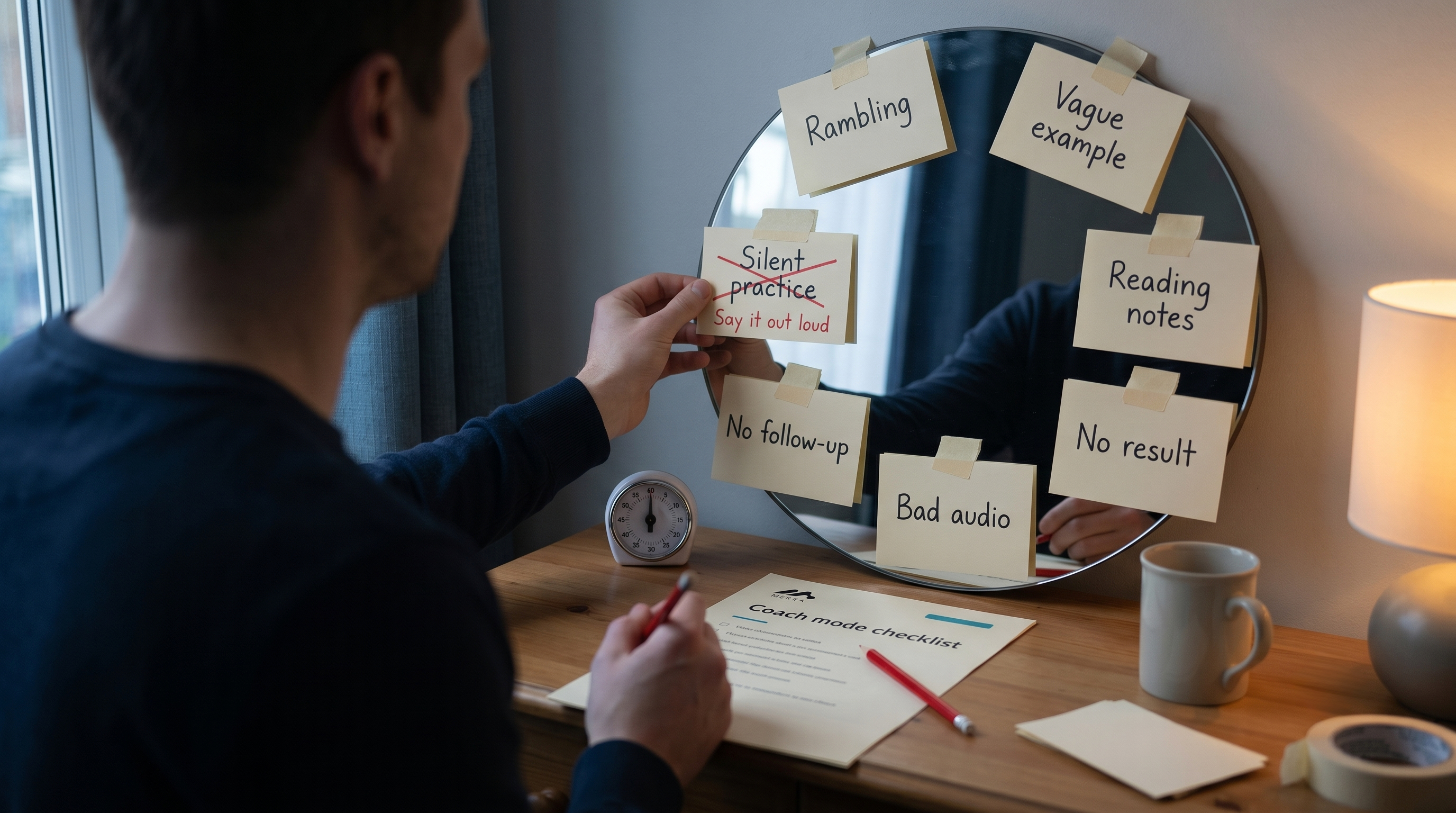
5. Practise out loud, not just in notes
Writing answers is useful. Reading them silently is not enough.
Interviews are spoken. You need to practise the performance, not just the content.
Use this drill:
Pick one question.
Answer out loud without notes.
Record yourself once.
Listen for structure, pace and clarity.
Repeat with a cleaner version.
You do not need to become polished to the point of sounding fake. You need to sound clear, calm and specific.
If the first time you say an answer out loud is in the real interview, you are making it harder than it needs to be.
6. For in-person interviews, plan the boring details
In-person interviews add practical pressure. You have to get there, enter the building, meet people, sit in the room and manage your body language.
Plan the basics the day before:
Route and travel time
Backup route
Outfit
Printed CV copies
Notebook and pen
Name of the person you are meeting
Building entrance or reception instructions
A quiet place nearby in case you arrive early
Aim to arrive near the building 15 to 20 minutes early, but do not walk into reception too early. Five to ten minutes before the scheduled time is usually enough.
Bring a bag if you need one. Bring printed CVs even if they probably already have it. Bring a notebook. These things make you look prepared because you are prepared.
7. Body language should be calm, not performative
You do not need fake confidence. You need calm presence.
In person, focus on:
Sitting upright but not stiff
Making natural eye contact
Not interrupting
Nodding when you understand the question
Keeping your hands still enough that they do not distract
Smiling when it is natural, not constantly
For video interviews, look at the camera when giving the main point, not at your own face. Put your notes near the camera if you use them. Keep your background simple.
Body language will not save a weak answer, but it can make a good answer easier to trust.
8. Answer the question they asked
This sounds obvious, but it is one of the most common interview mistakes.
Candidates hear a keyword, jump into a rehearsed story, and forget the actual question.
If they ask:
Tell me about a time you disagreed with someone.
Do not give a generic teamwork answer. They are testing disagreement, judgement and communication.
If they ask:
Tell me about a time you worked under pressure.
Do not just say you were busy. Show prioritisation, trade-offs and outcome.
Before answering, take one second and identify the skill being tested. Then choose the story that proves it.
9. Ask better questions at the end
The end of the interview is not a throwaway moment. Good questions show how you think.
Avoid questions you could answer with a quick website search.
Better questions:
What would success look like in the first 90 days?
What separates someone good in this role from someone excellent?
What are the biggest challenges the team is trying to solve this year?
How would you describe the working style of the team?
What is one thing you wish more candidates understood about this role?
For graduate schemes or internships, ask about learning curve, support, feedback and what strong previous candidates did well.
Do not ask all of them. Pick two or three.
10. Follow up like a normal person
After the interview, send a short thank-you message if you have the interviewer's email or recruiter contact.
Keep it simple:
Thank you for taking the time to speak with me today. I enjoyed learning more about the role and the team. The discussion made me even more interested in the opportunity, especially the work around [specific detail]. Please let me know if there is anything else I can provide.
That is enough. Do not write an essay. Do not oversell. Do not chase the same day if they already gave you a timeline.
If you have not heard back after the timeline they gave you, follow up politely.
A simple 48-hour interview prep plan
If your interview is soon, use this plan.
48 hours before
Read the job description carefully
Build your 7-story bank
Research the company, team and role
Prepare answers to tell me about yourself, why this role and why this company
Prepare 3 questions to ask them
24 hours before
Practise 5 answers out loud
Do one mock interview with a friend, careers service or Merra
Plan your outfit, route and materials
Print your CV if the interview is in person
Sleep instead of over-preparing late at night
Day of the interview
Re-read your story bank, not a script
Check travel or video setup
Arrive early, but not awkwardly early
Take a breath before answering
Answer the question asked
Ask your prepared questions
How Merra fits into general interview prep
Merra Practice is not only for AI interviews. It is useful any time you need to practise answering interview questions out loud before the real thing.
Use it to:
Practise your 7-story bank
Stress-test STAR answers
Find where you ramble
Get follow-up questions
Build confidence speaking under pressure
When you sign up, you get one free interview in Coach mode. The Practice tier includes Interview mode, Coach mode and Beast mode. The Pro tier unlocks all 9 AI personalities.
Start at trymerra.ai/practice.
Bottom line
A strong interview is not about having perfect answers. It is about being prepared enough to be present.
Know the role. Know your stories. Practise out loud. Listen carefully. Answer the question. Ask thoughtful questions. Follow up simply.
That is what makes you feel calm in the room, and that is what makes an interviewer trust you.
About the founder
Ahmed Ghelle is the founder of Merra. Merra builds voice-based mock interviews that talk back, helping students and graduates prepare for real interviews across consulting, banking, graduate schemes and early-career roles. He writes about interview preparation, hiring and the gap between knowing what to say and being able to say it under pressure.