How to pass an AI interview
To pass an AI interview, your answers need to be clear, specific, structured and spoken naturally out loud. The best candidates do not try to trick the AI. They answer the question like they would in a real first-round interview: one clear point, one strong example, a concrete result, and no rambling.
The biggest mistake is treating the format as either a robot game or a casual recording. It is neither. It is still an interview. The format is different, but the scoring signal is familiar: relevance, communication, evidence, judgement and consistency.
This guide covers the 7 mistakes that quietly lose candidates the next round, and what to do instead.
What an AI interview is usually looking for
Different AI interview platforms work differently. Some are one-way video tools. Some are conversational voice interviews. Some are scored by AI first, then reviewed by a human. Some focus heavily on the transcript. Others may also consider delivery signals like pace, clarity or confidence.
So do not assume every AI interview scores the exact same things.
But across most AI and video interview formats, strong answers have the same pattern:
You answer the question asked
You give a specific example
You explain what you personally did
You show the result
You speak clearly enough to be understood
You finish before the timer or flow cuts you off
That is the foundation. Now here are the 7 things candidates get wrong.
Mistake 1: Practising silently in your head
This is the most common mistake.
Candidates read a list of common questions, think through a few answers, maybe write bullet points in a document, and feel prepared. Then the real interview starts and the answer does not come out the way it sounded in their head.
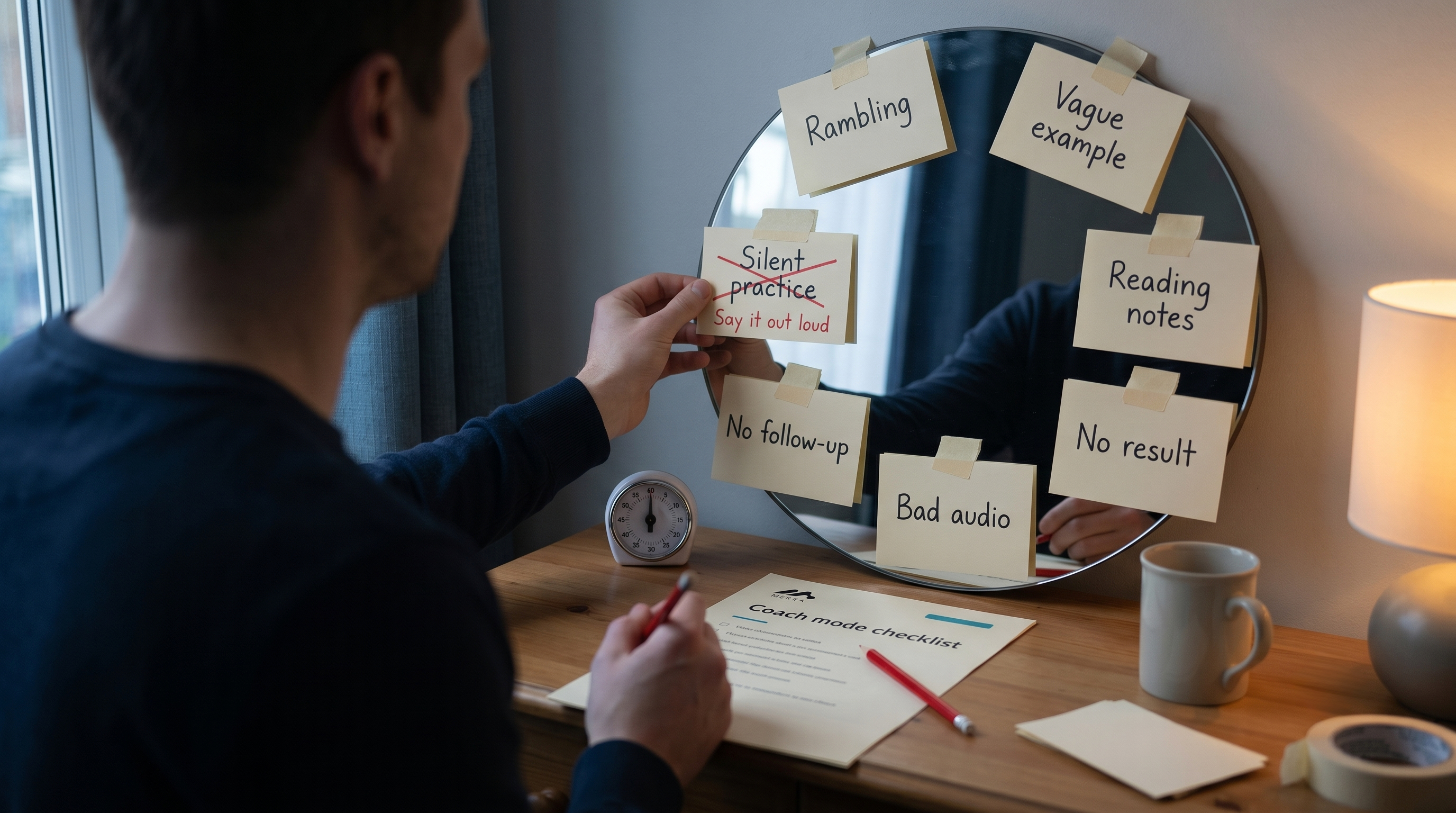
Silent practice is not interview practice.
An AI interview tests spoken performance. You need to practise:
Starting without a long pause
Speaking in full sentences
Keeping your answer organised
Recovering if you lose your thread
Finishing cleanly
What to do instead:
Pick 5 common questions and answer each one out loud. Record yourself once. You do not need to watch every second, but listen for the obvious issues: too fast, too vague, too long, too flat, too many filler words.
A simple drill:
Pick a question.
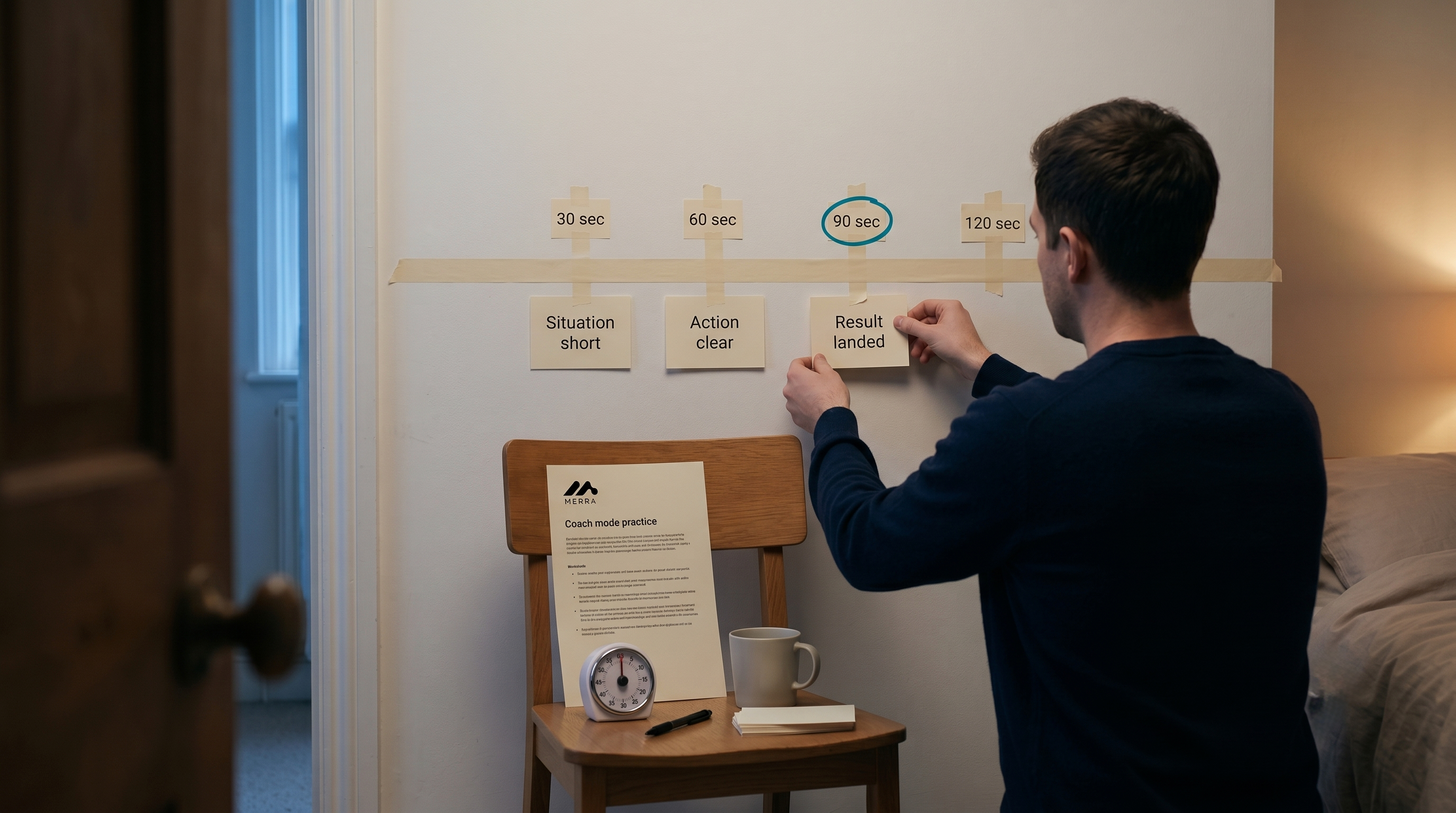
Set a 90 second timer.
Answer out loud.
Write down where you got lost.
Repeat once, cleaner.
That is much better than silently reviewing 30 questions.
Mistake 2: Rambling instead of answering the question
AI interviews can feel awkward because there is often no human nodding along. Candidates fill the silence by talking more. That is how answers become long, messy and hard to score.
Rambling usually happens when you start before you know your structure.
Weak pattern:
I guess there are a few things I could talk about, and one time that comes to mind was during university, although there were a lot of different parts to it, and I think what happened was...
By the time you reach the actual point, the listener has lost the thread.
Better pattern:
One example was during a university group project where our deadline moved forward by a week. I was responsible for reorganising the work plan, so I split the project into three priorities, reassigned tasks based on who had capacity, and set a daily check-in. We submitted on time and received a first-class mark.
That answer is not perfect, but it is clear.
What to do instead:
Use a simple 4-part shape:
Direct answer
Situation
Action
Result
If you cannot name the result, the answer probably is not ready yet.
Mistake 3: Giving vague examples
Vague answers sound safe, but they do not prove anything.
Weak answer:
I am a good communicator because I always try to listen to people and make sure everyone is included.
That sounds nice, but it gives the interviewer nothing to evaluate.
Stronger answer:
In my part-time retail job, I had to calm down a customer who was frustrated about a delayed order. I listened first, repeated back the issue, checked the order status, and offered two options: a refund or a replacement delivery. They chose the replacement, and my manager later asked me to show the same approach to a new team member.
The second answer is better because it has a real moment, a real action and a real outcome.
What to do instead:
For every answer, ask yourself:
When did this happen?
What was my role?
What did I personally do?
What changed afterwards?
If you cannot answer those four questions, your example is probably too vague.
Mistake 4: Reading notes like a script
Notes are not always bad. Scripts are.
A few short prompts near your camera can help you remember your structure. But reading full sentences usually sounds unnatural. In a video interview, it can also make your eyes move away from the camera in a way that looks obvious.
The problem is not just whether the system can detect reading. The bigger problem is that scripted answers sound less believable. Real interviewers, human or AI-assisted, are looking for evidence that you can think and communicate in the moment.
What to do instead:
Use bullet prompts, not scripts.
Good notes:
Team project
Deadline moved
Replanned tasks
Daily check-ins
Submitted on time
Bad notes:
Full paragraphs
Exact sentences
Over-polished wording
Anything you cannot say naturally
Your goal is to sound prepared, not memorised.
Mistake 5: Ignoring the room, audio and camera
Content matters most, but setup still matters. If the reviewer cannot hear you clearly, your answer gets weaker before the content is even judged.
Common setup mistakes:
Speaking too far from the microphone
Sitting with a bright window behind you
Looking at your own face instead of the camera
Having notifications pop up
Using a messy or distracting background
Starting without testing the platform
You do not need a studio. You need a quiet, clear, boring setup.
What to do instead:
Before the interview:
Test your microphone
Put your camera at eye level
Face a window or lamp, do not sit with it behind you
Close notifications
Put your notes near the camera, not down on the desk
Record a 20 second test clip and play it back
If you only do one thing, test the audio. Bad audio is worse than imperfect lighting.
Mistake 6: Trying to trick the AI
Some candidates search for hacks: special keywords, fake enthusiasm, perfect facial expressions, or ways to game the system.
This is the wrong mindset.
Most AI interview systems are not looking for a magic phrase. They are trying to extract signal from your answer: what you did, how you think, how clearly you communicate, and whether your experience matches the role.
Trying to sound like a perfect candidate often makes you sound generic.
Weak pattern:
I am highly motivated, passionate, adaptable, resilient and a strong team player.
Better pattern:
I had to adapt quickly when our project sponsor changed the brief two days before submission. I set up a 20 minute call with the team, clarified what had changed, and rebuilt the task list around the new priorities.
Specific beats polished.
What to do instead:
Do not ask, "What does the AI want to hear?"
Ask, "What real example proves this?"
That question leads to better answers.
Mistake 7: Not practising follow-ups
One-way video interviews may not ask follow-ups, but conversational AI interviews can. Human reviewers can also judge whether your first answer leaves obvious gaps.
If your example cannot survive one follow-up, it is too thin.
A weak story collapses when asked:
What exactly did you do?
What was difficult about it?
What was the result?
What would you do differently?
How did you know it worked?
What to do instead:
After each answer, ask yourself one follow-up:
If they pushed me on this, what would I say next?
For example, if your answer says you "led the team," be ready to explain:
How many people were in the team?
What decision did you make?
How did you handle disagreement?
What changed because of your leadership?
Merra is useful here because it can ask follow-ups instead of letting you stop at the first polished answer.
The 7 mistakes checklist
Before your AI interview, check you are not doing these:
Practising silently instead of out loud
Rambling without a structure
Giving vague examples
Reading a script
Ignoring audio, camera and room setup
Trying to trick the AI
Avoiding follow-up practice
If you fix those 7 things, you will already be ahead of most candidates.
What a strong AI interview answer sounds like
A strong answer is usually not complicated. It sounds like this:
One example was during my final-year project, where our team realised halfway through that our survey response rate was too low to support our argument. I was responsible for the research plan, so I redesigned the survey, shortened it from 18 questions to 8, and sent it through three student groups with a clearer message. We increased responses from 34 to 112 in four days, which gave us enough data to make the analysis credible. That taught me to remove friction when I need people to take action quickly.
Why it works:
It starts quickly
It gives context without overexplaining
It says what the candidate personally did
It includes a number
It ends with a reflection
That is what you are aiming for.
How to use Merra to practise
Merra Practice helps you rehearse the real first-round AI interview before it counts. You answer out loud, get follow-up questions, and review feedback on what you actually said.
Use it like this:
1. Start with Coach mode
When you sign up, you get one free interview in Coach mode. Use it to find your biggest problem: rambling, weak structure, vague examples, timing or delivery.
2. Move to Interview mode on the Practice tier
On the Practice tier, use Interview mode to simulate the real thing. No stopping, no restarting, no overthinking. Just answer and review.
3. Use Beast mode when you are too comfortable
The Practice tier also includes Beast mode. Use it when your answers are basically solid and you want more pressure.
4. Use Pro when you want all 9 AI personalities
The Pro tier unlocks all 9 AI personalities, so you can practise against a wider range of interviewer styles.
You can start at trymerra.ai/practice.
Bottom line
Passing an AI interview is not about becoming robotic. It is about becoming clear.
The candidates who do best are not the ones with perfect scripts. They are the ones who can explain a real example, out loud, under pressure, without drifting away from the question.
Practise speaking. Use specific examples. Land the result. Leave the hacks alone.
About the founder
Ahmed Ghelle is the founder of Merra. Merra builds voice-based AI mock interviews that talk back, helping students prepare for consulting, banking, and graduate scheme interviews. He writes about hiring, interview preparation, and the gap between how people practise and what actually works.