What an MMI actually is
The Multiple Mini Interview is a circuit-style interview format used by most UK medical schools and a growing number of dental and allied-health schools. Instead of one 30-minute panel interview, you rotate through a series of short stations:
Number of stations: usually 6-10
Time per station: usually 5-8 minutes (some schools include 1-2 minutes of reading time outside each room)
Format per station: a single scenario, question, role play, or task, with one or two assessors scoring you
Total length: usually 60-90 minutes including transitions
Each station is independent. The assessor at station 4 doesn't know how you did at station 3. They score you only on the scenario in front of them, against a fixed rubric. That's the entire design intent: MMI tries to give every applicant multiple bites at the apple so a single bad moment doesn't sink the application.
The practical upshot for you as a candidate: consistency beats brilliance. A solid 7-out-of-10 across all 8 stations will beat a 9-3-9-2-9-3 pattern almost every time.
Which UK medical schools use MMI
Most UK medical schools have moved to MMI or a hybrid MMI-plus-panel format over the last decade. The specific list changes year to year, so always check your school's current admissions page before you finalise your prep, but as a general guide for 2026 entry:
MMI is used at most UK undergraduate medicine courses, including Imperial (hybrid: an asynchronous online portion plus 7 in-person stations of ~5 minutes each), UCL (newly switched to MMI for 2026 entry, having historically used a 20-minute panel interview), Birmingham, Manchester, Leicester, Brighton and Sussex (6-7 stations of ~8 minutes), Plymouth, Exeter, and most others.
Edinburgh runs an Assessment Day rather than a pure MMI - usually a short MMI of around 3 stations plus a group task. Edinburgh only invites roughly the top 700 applicants (ranked by academic record, UCAT and SJT), so the interview sits inside a heavily selection-based process.
Oxford and Cambridge use panel-style interviews (typically two panels of around 20-45 minutes each, science-heavy at Cambridge), designed to feel like a tutorial or supervision.
For every other school on your list, check their official admissions page. Format details (station count, station length, online vs in-person, any asynchronous video component) vary year to year and even cycle to cycle.
The rule of thumb: if you're applying to a UK undergraduate medicine course outside of Oxbridge, assume MMI until the school's admissions page tells you otherwise. If you're applying to Oxbridge, prepare for a panel-style interview that feels like a tutorial - that's a different beast and not what this guide covers.
How MMI scoring actually works
Understanding the scoring tells you what to optimise for. At every station, the assessor scores you against a fixed rubric. The rubrics vary by school but they almost always cover some version of:
Quality of reasoning - did your thinking process make sense?
Communication - did you express it clearly, calmly, at the right pace?
Empathy and ethics - did you show awareness of the people in the scenario?
Specificity - did you bring concrete examples, not platitudes?
Insight and self-awareness - did you reflect on your own role honestly?
What the rubrics almost never reward:
Memorised answers that don't engage with the specific scenario
Listing facts about the NHS / GMC without applying them
Aggressive certainty on ethical dilemmas (there's almost always more than one defensible answer)
Talking over the simulated patient or assessor
Padding to fill the time
At the end of the circuit, your scores are summed (or in some schools averaged) into a total MMI score, which is combined with your UCAT or BMAT and your personal statement to produce your overall ranking. Different schools weight the MMI differently - at some it's the dominant input alongside your UCAT, at others it sits alongside academic score and a separate SJT or group task. The school's admissions page will tell you the actual weighting; treat any specific percentage in a generic prep guide (this one included) as a rough sketch, not a number to bank on.
The 8 MMI station types you'll face
Almost every MMI station fits into one of these eight buckets. Building a story bank and a structure for each bucket covers the vast majority of what you'll see on the day.
1. Ethical scenario
"A 16-year-old patient asks you not to tell her parents she's been prescribed the contraceptive pill. What do you do?"
What the assessor wants: structured reasoning that names the principle (Gillick competence, confidentiality, capacity, safeguarding), considers more than one stakeholder, and lands on a defensible position without claiming certainty.
Useful scaffold: stakeholders → principles → tensions → your position → what would change your mind.
2. Role play (simulated patient or relative)
"In this station you'll meet Mr Hassan, whose wife was admitted last night. Please break the news that she has been moved to intensive care."
What the assessor wants: actual conversation, not a monologue. Real warmth. Pauses. Checking what the person already knows. Using their name. Sitting at their level. Avoiding medical jargon. Asking what support they need.
Useful scaffold: SPIKES (Setting, Perception, Invitation, Knowledge, Empathy, Strategy and Summary). You're not expected to be a doctor; you're expected to be a human being who can be trained to be one.
3. Communication task
"Explain to the assessor, who has never used one, how to tie a shoelace. You have 4 minutes."
What the assessor wants: clear structure (steps in order), checking understanding mid-way, adjusting language when something isn't landing, calm pacing.
Useful scaffold: chunk → check → continue. Three steps, then check the assessor is following, then the next three.
4. Data interpretation or calculation
"Here are three trial results for a new diabetes drug. Which would you prescribe and why?"
What the assessor wants: numerical literacy without panic. Naming the relevant numbers (absolute risk, relative risk, number needed to treat, confidence interval if shown), saying what you don't know, and giving a recommendation with reasoning.
Useful scaffold: what the data says → what it doesn't say → what you'd want to know more about → provisional answer.
5. "Why medicine?" and "Why this school?"
"Why do you want to be a doctor? Why our medical school?"
What the assessor wants: specificity. Not "I want to help people". The story of the specific shift, conversation, patient or family event that made you want this. For the school, three concrete reasons that could only be true of this school - their PBL vs lecture mix, their early clinical exposure year, their specific anatomy teaching format, the rural placement programme.
Useful scaffold: specific moment → what you learned → what you did about it next → what you'll bring to the course.
6. Personal reflection
"Tell me about a time you failed at something. What did you learn?"
What the assessor wants: an actual failure, not a humblebrag failure. Honest reflection on what you contributed to it going wrong, not blame on circumstances or other people. A specific thing you changed afterwards.
Useful scaffold: STAR with the result being what you changed in yourself, not what you fixed externally. The strongest answers have a small but real change in behaviour.
7. Teamwork or leadership scenario
"You're working in a clinical team and a colleague is consistently late. How do you handle it?"
What the assessor wants: thinking before acting (why might they be late?), starting with a one-to-one conversation rather than escalation, balancing the team's needs against the individual's, knowing when escalation becomes appropriate.
Useful scaffold: understand → talk privately → support → escalate if needed → reflect on your own contribution to the team dynamic.
8. Personal qualities and empathy
"Describe a time you supported someone going through a difficult time. What did you do, and what would you do differently now?"
What the assessor wants: real warmth in the way you talk about the person, recognition that you didn't fix it (because you usually can't), and a specific small action you took (sat with them, made sure they ate, helped them book the GP appointment). The strongest answers admit what you got wrong.
Useful scaffold: the person and what they were going through → what you did → what you got right → what you got wrong → what you'd do differently.
10 real MMI questions with the structure that scores
These are representative of what you'll actually see. Practise out loud, not in your head.
Ethics
"A patient refuses a blood transfusion on religious grounds. They will die without it. What do you do?"
Stakeholders: patient, family, medical team. Principles: autonomy, beneficence, capacity. Tensions: autonomy vs life. Position: respect refusal if capacity confirmed; document everything; offer alternatives. What would change your mind: signs of impaired capacity, family coercion.
"You see a fellow medical student cheating in an exam. What do you do?"
Stakeholders: the student, future patients, the school, you. Principles: professional integrity, fitness to practise, fairness. Position: speak to the student first; report if not resolved. What would change your mind: nothing - this is a fitness-to-practise issue.
Role play
"Tell this simulated patient that the lump on their arm is benign. They are extremely anxious."
Sit down. Use their name. Check what they already understand. Deliver the result clearly. Pause for their reaction. Acknowledge the anxiety. Explain next steps. Ask what other support they need.
"This actor is a relative of a patient who has just died. Please support them in the next 4 minutes."
Sit at their level. Name what happened plainly. Don't fill silence. Let them lead the pace. Offer practical next steps when they're ready (chaplaincy, bereavement officer, calling family).
Communication
"Explain to this assessor what photosynthesis is. They have not studied science since school."
Start with the headline ("plants turn sunlight into food"). Build up from there in chunks. Check understanding at each step. Use analogies. Avoid jargon.
Data / calculation
"This drug reduces stroke risk from 8% to 6% over 5 years. Would you prescribe it?"
Absolute risk reduction is 2%. Number needed to treat is 50. That's the headline. What's the side effect profile? What's the cost? What's the patient's baseline risk and preferences?
Why medicine / why this school
"Why do you want to be a doctor?"
One specific moment. What you learned from it. What you did next (work experience, volunteering, reading, shadowing). What you'll bring to the course.
"Why our medical school over the others on your list?"
Three concrete reasons that could only be true of this school. At least one of them needs to be a curriculum or teaching feature, not just "the city is nice".
Reflection
"Tell me about a time you received feedback you didn't agree with. What did you do?"
The feedback. Your initial reaction (be honest). What you did to test whether it was right. What you concluded. What you changed.
Teamwork
"You're leading a group project and one member isn't contributing. How do you handle it?"
Why might they not be contributing (workload, personal issues, unclear scope, motivation)? One-to-one conversation. Reset expectations. Support them if there's a personal issue. Escalate only if the behaviour continues. Reflect on whether the project structure set them up to fail.
The 4-week MMI prep plan
This assumes you have your interview invitation and roughly 4 weeks until the date. Compress proportionally if you have less time.
Week 1: Ethics and reflection
Read the GMC's Good Medical Practice and the BMA's medical ethics toolkit. Two evenings.
Build a story bank: 8-10 stories from the last 2 years across work experience, volunteering, school leadership, sport / music, and personal reflection. Tag each one to the 8 station types.
Run 5 ethical scenarios out loud with the stakeholders → principles → tensions → position → what would change your mind scaffold.
Week 2: Communication and role play
Practise breaking bad news using SPIKES. Real out-loud practice with a friend or family member playing the simulated patient.
Practise the "explain X to someone with no background" communication task. Run 3-4 different topics (photosynthesis, tying a shoelace, why the sky is blue, how a bank works).
Watch your "we" vs "I" ratio in role plays. The actor is one person. You are the other. Speak directly to them.
Week 3: Calculation and "why medicine"
Brush up on absolute vs relative risk, number needed to treat, confidence intervals, basic probability. Don't go deep - just confident with the headline metrics.
Write your "why medicine" answer until it has one specific moment, what you learned, and what you did next.
Write a "why this school" answer for each of your interview schools. Three specific reasons per school. At least one curriculum feature.
Week 4: Timed full mock circuits
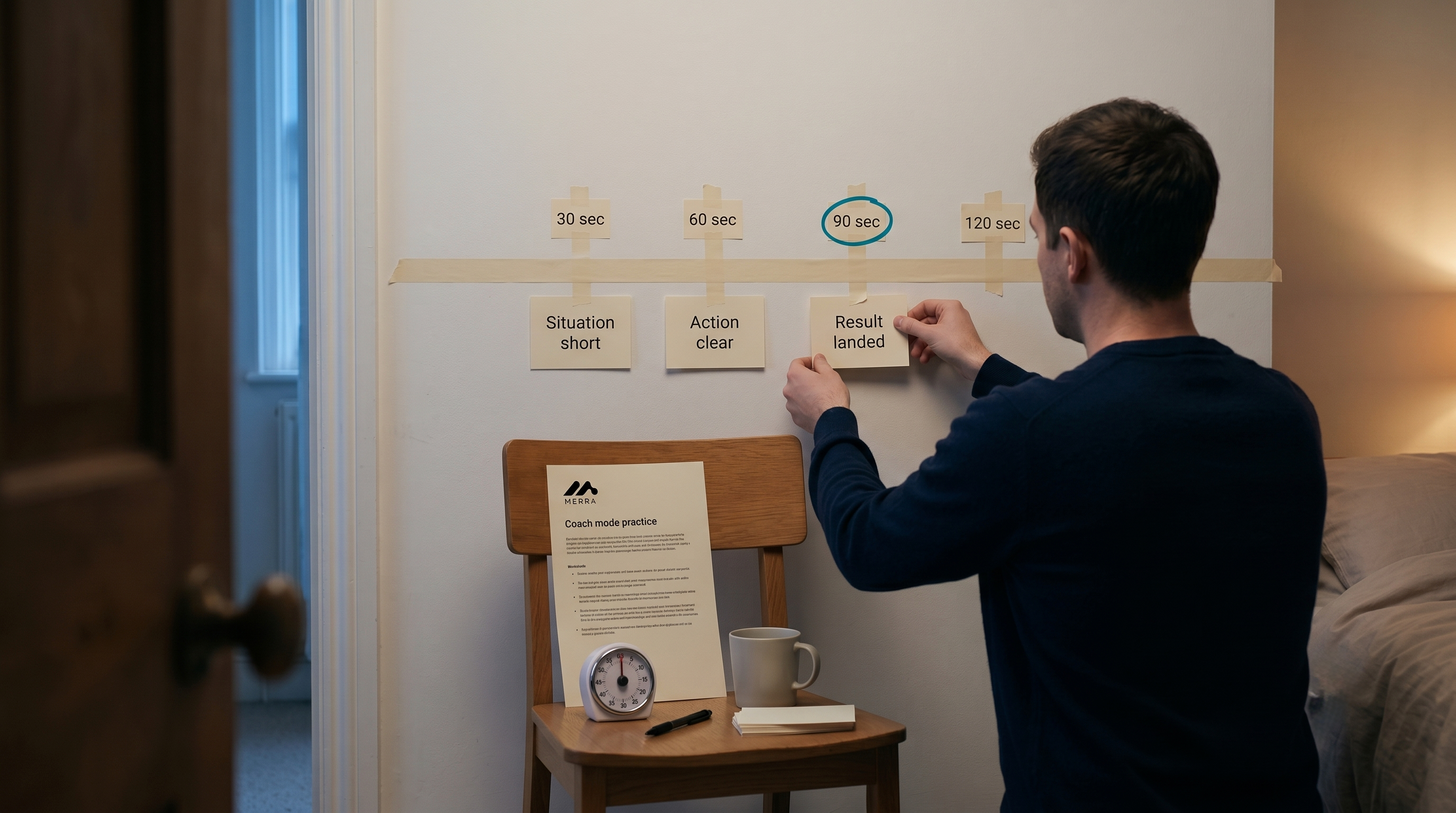
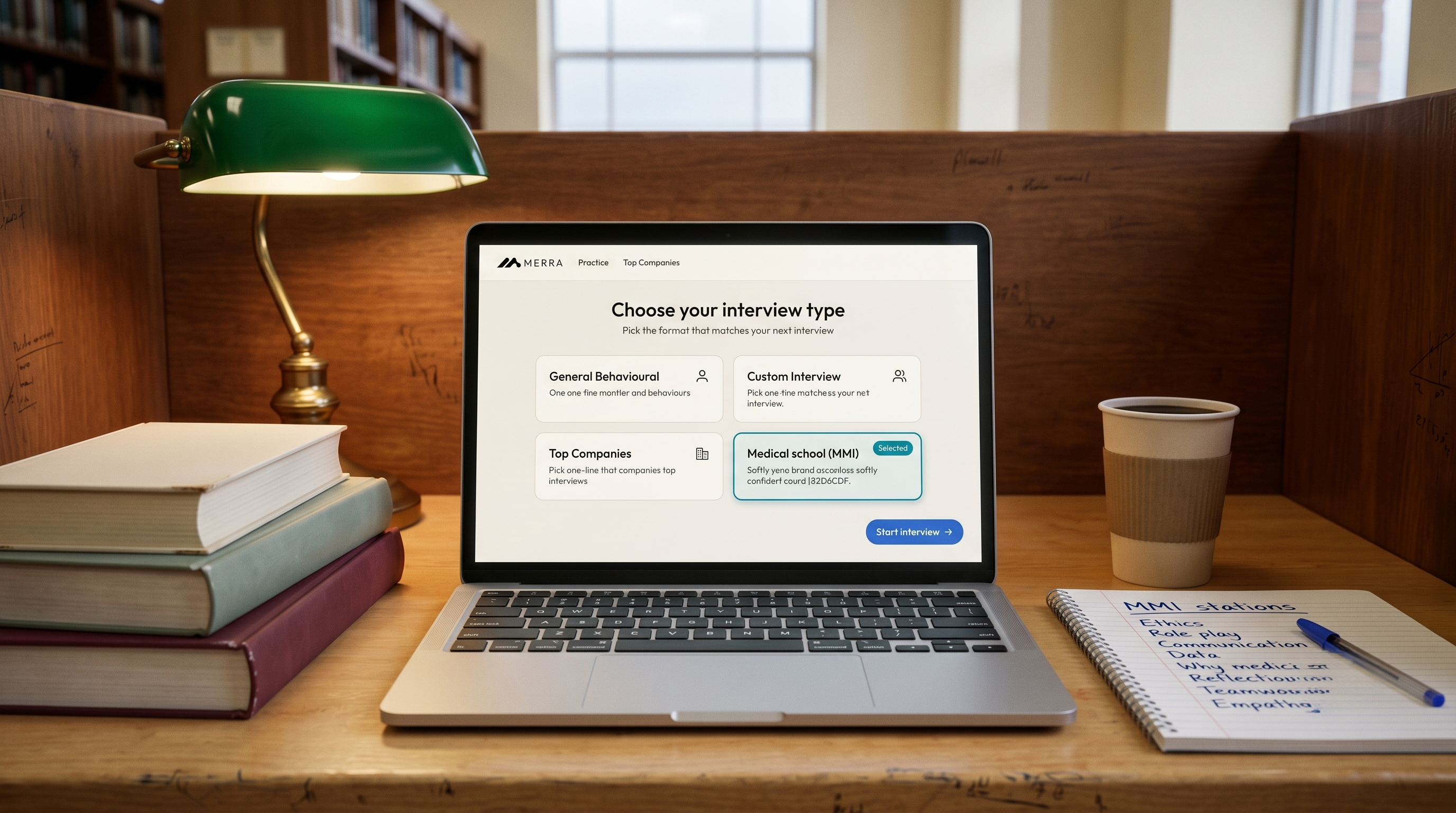
Run two full timed circuits a week. 8 stations, 5 minutes each, 1 minute transition. Use Merra Practice with the Medical school (MMI) target so the AI runs MMI-style stations with follow-ups and gives you a transcript and feedback at the end.
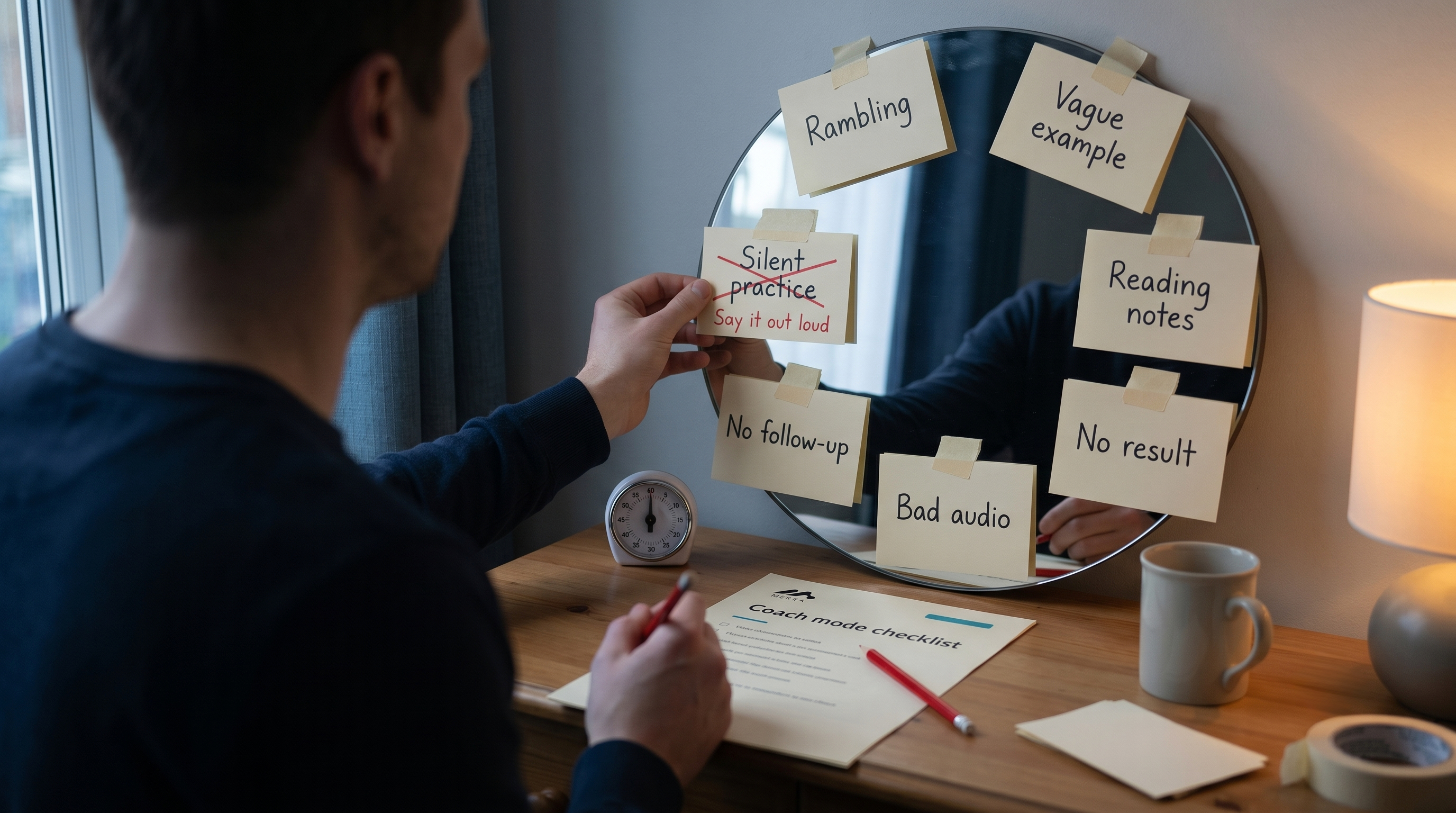
Switch between Coach Mode (the AI stops you mid-answer to coach you in real time) when you want to fix a specific station, and Interview Mode (the real thing, no resets) when you want to test consistency under pressure.
Self-record one circuit on your laptop webcam in a quiet room. Watch it back at 1x. Fix the obvious tells (filler words, fidgeting, jargon).
If you've only got a week or two
Compress hard:
Days 1-2: Build the 8-10 story bank, tagged to the 8 station types. Write your "why medicine" and "why this school" answers for each school.
Days 3-4: Run through one practice scenario for each of the 8 station types. Out loud. Time them.
Days 5-6: Run a full timed mock circuit on Merra Practice's MMI target. Then run another one. Fix the weakest 2 stations.
Days 7-10: Daily practice. Mix Coach Mode for fixing weaknesses and Interview Mode for consistency.
Days 11-14: Light only. One circuit every other day. Sleep. Don't try to learn anything new in the last 48 hours.
The 5 MMI mistakes that quietly fail candidates
1. Memorised answers that don't engage with the actual scenario
The assessor will spot this immediately. The rubric scores you on engaging with this scenario, not on reciting a model answer to a similar one. Always start by reading the actual question on the door.
2. Aggressive certainty on ethics
Medical ethics stations almost never have a single right answer. Confident "I would absolutely do X" answers score lower than measured "I'd lean toward X because of these principles, and I'd want to know Y before I committed."
3. Treating role play like a monologue
The simulated patient is the other person in the conversation. Talk with them, not at them. Pause. Let them respond. Ask them questions. Acknowledge what they said.
4. Generic "why this school"
If your "why Manchester" answer could be pasted into your "why Leeds" answer with no edits, you fail this station. Three specific, school-only reasons per school. At least one curriculum feature.
5. Practising silently in your head
This is the single biggest avoidable mistake. Reading your story bank in your head is not the same as saying it out loud against a real prompt with a real timer. The first time you hit a tough MMI station shouldn't be on the day.
Run the practice
Merra Practice lists Medical school (MMI) as a supported interview target, and tailored prep pages are rolling out weekly. The first interview is free and no card is needed. You can pick between the two modes that are available on every plan:
Interview Mode runs structured stations with adaptive follow-ups and gives you a recording, transcript and detailed feedback at the end - the closest thing to the real circuit.
Coach Mode stops you mid-station to coach you in real time. The AI catches filler words, pulls you back when you wander off-question, and helps you tighten your structure before moving on.
Both Interview Mode and Coach Mode are included on the free plan.
If you want to push harder once your fundamentals are in place, the Pro plan adds more interviewer personalities (Beast, Skeptic, Silent Treatment, Devil's Advocate, Rapid Fire, Hype, and Curveball Mode) that are rolling out soon - useful when you want to train for the assessor who gives you nothing back, or the one who pushes on every claim.
🩺 Run a free MMI-style mock interview on Merra Practice and find out which stations actually hold up under pressure.
Ahmed Ghelle is the founder of Merra, an AI interviewing platform that runs structured first-round interviews on every applicant and produces a recording, transcript, and scored evaluation for each one. He writes about hiring, evidence, and the difference between speed and signal.