What STAR actually is, in one paragraph
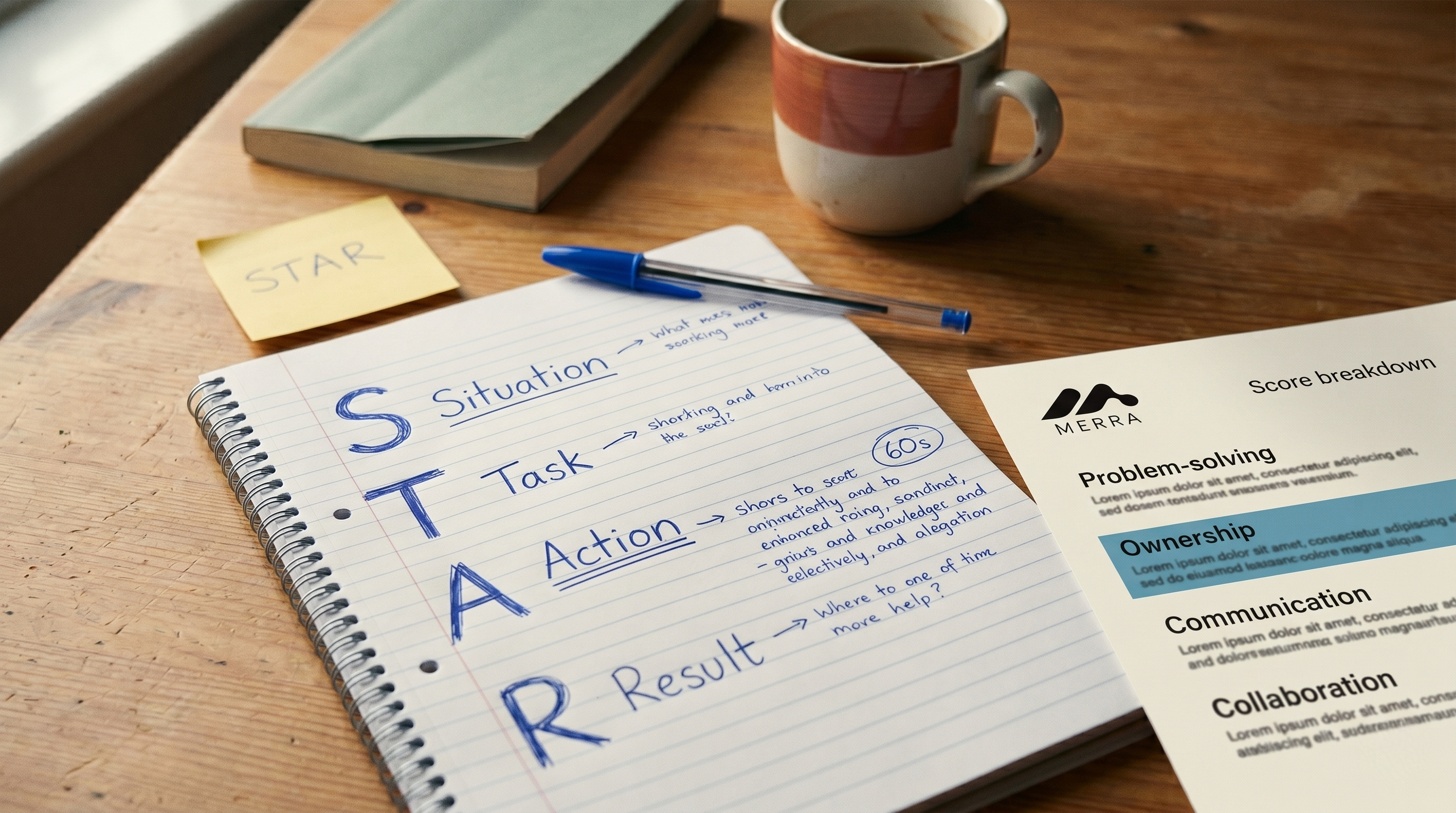
STAR is a 4-part structure for answering behavioural interview questions: Situation, Task, Action, Result. You set the scene briefly, name what you were responsible for, describe what you specifically did, and finish with the measurable outcome. It's been the standard structure recommended by graduate recruiters for decades. The difference in 2026 is that AI interview platforms now score the transcript of your answer against role-specific competencies, and STAR happens to map cleanly onto how those scoring systems read what you said.
Why STAR specifically works for AI interviews
Modern AI interview platforms transcribe what you say and score the transcript against role-specific competencies. HireVue dropped facial analysis in 2021 and now scores transcripts only. Sapia and Paradox are text-based by design. The AI is reading sentences, not vibes.
Each part of STAR maps onto something useful on that transcript:
Situation gives enough context for the rest of the answer to make sense. Without it, the strongest evidence reads as a floating claim.
Task signals ownership and scope, which most employers care about.
Action is where the competencies the AI is checking actually live: problem-solving, communication, ownership, collaboration, customer focus. The verbs you choose ("I built", "I asked", "I decided") are the evidence.
Result signals whether the action actually worked. A measurable outcome gives the AI and the reviewer something concrete to anchor the result on. A vague one gives them nothing.
A well-structured STAR answer makes those competencies easy to spot in the transcript. A rambling answer with no structure hides them, even if the underlying story was strong.
The 10-20-60-10 guideline
The single most common failure mode in AI interview answers is over-investing in Situation and under-investing in Action. Candidates tell a long backstory about the project and then run out of time before they've described what they personally did.
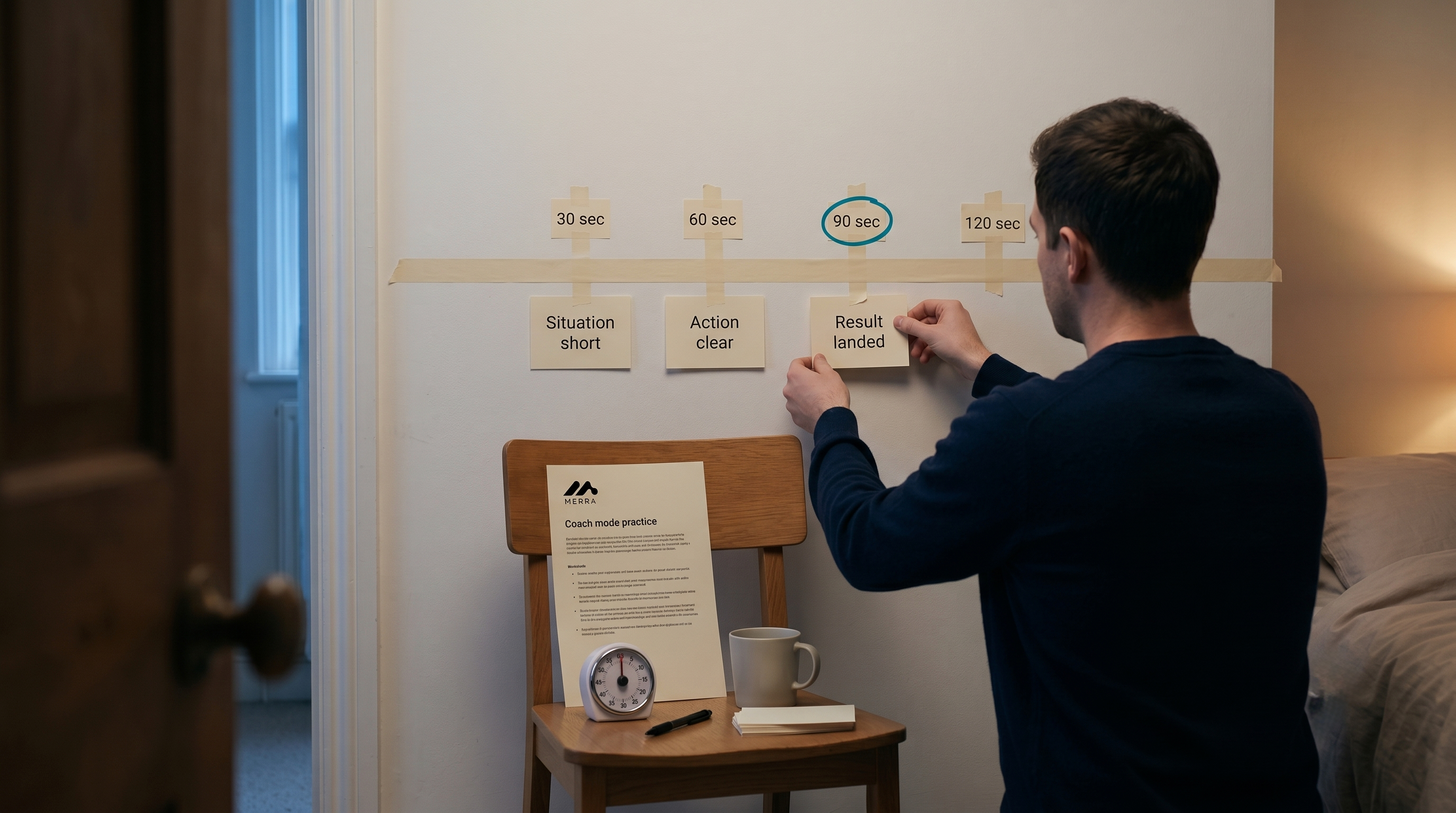
A clean STAR answer roughly distributes itself like this for a 2-minute answer:
Situation: ≈12 seconds (one sentence of context, no backstory)
Task: ≈24 seconds (one or two sentences naming what you were responsible for)
Action: ≈70 seconds (the meat, your specific decisions, your specific verbs)
Result: ≈12 seconds (a measurable outcome where possible)
Action is the longest part by a wide margin. If you time yourself answering and Situation is taking more than 15 seconds, cut it.
Each letter in depth (and the common mistake for each)
S - Situation
What it is: One sentence of context so the AI and the reviewer know what you were working on.
Common mistake: Treating it as the introduction to your CV. "Last summer I was interning at..." and then three more sentences about the company, the team size, the office location, the project history.
Do this instead: Compress the situation into one clear sentence. "In my second-year economics group project, we were modelling consumer demand for a major UK retailer." Done. Move on.
T - Task
What it is: What you were specifically responsible for. Not what the team was doing. What you owned.
Common mistake: Describing the team's goal instead of your role. "Our team needed to deliver a final report by week six."
Do this instead: Anchor your specific responsibility inside the team. "I owned the data analysis stream: five datasets, three of them messy, due 48 hours before the team's final write-up."
A - Action
What it is: The specific decisions and actions you took. The longest and most important part of the answer. Verbs starting with I, not we.
Common mistake: Using we throughout. "We decided to...", "We split the work...", "We pivoted to..." If the answer is wall-to-wall we, the reviewer can't tell what was yours.
Do this instead: When you have to talk about a team decision, attribute your specific contribution. "The team decided to pivot the methodology; I argued for the change, sketched out the new approach in a one-page memo, and walked the team through it on the call." Now the contribution is visible inside the team move.
R - Result
What it is: The measurable outcome. The result tells the AI (and the reviewer) whether the action actually worked.
Common mistake: Vague results. "It went well." "The team was happy." "We learned a lot."
Do this instead: Quantify where you can. "We placed second out of 40 teams." "Our methodology became the team's working method for the rest of the year." "My manager extended the placement by two weeks based on the project." If you genuinely can't quantify, name the specific durable change. "My line manager asked me to teach the rest of the team my process the following week" is a strong qualitative result.
Three worked examples
Three full STAR answers, timed to 2 minutes each, for three of the most common behavioural questions.
Example 1 - "Tell me about a time you worked in a team"
"In my second-year economics group project, we were modelling consumer demand for a major UK retailer for a real industry partner. I owned the data analysis stream: five datasets, three of them messy, due 48 hours before the team's final write-up. When I started cleaning the datasets I noticed two of them used different definitions for the same product category, which would have broken our final model. I flagged the problem on our shared doc, drafted a quick reconciliation table that everyone could sanity-check, and walked the team through it on a call so we agreed the definitions before I committed to the analysis. We delivered the final report on time, placed second out of 40 teams, and the industry partner specifically called out the methodology section in their feedback."
Why it lands: Situation in one sentence. Task is specifically I-owned. Action is the bulk and uses I verbs ("I flagged", "I drafted", "I walked the team through"). Result is measurable and specific.
Example 2 - "Tell me about a time you took initiative"
"On my internship at a logistics company last summer, our team's weekly KPI report was being assembled manually every Friday morning by whoever drew the short straw. It took three hours and the numbers regularly had small errors. No one had asked me to fix it, but in my second week I asked my line manager whether I could rebuild it. She said yes if I could keep up with my actual deliverables. I spent two evenings building a Google Sheets template that pulled the numbers straight from the source dashboards, then ran it in parallel with the manual version for two weeks to check the numbers matched. After it was stable, I handed it off with a one-page how-to. The report now takes about fifteen minutes a week instead of three hours, and the team's been using my version since I left."
Why it lands: "No one had asked me to fix it" is the explicit signal that this is initiative, not assigned work. Action is specific ("two evenings", "ran it in parallel for two weeks"). Result is quantified (15 minutes vs 3 hours) and durable ("still being used").
Example 3 - "Tell me about a time you handled a conflict"
"On a group project in third year, I was running the analysis and a teammate wanted to swap the methodology two days before the deadline. My first instinct was no, since we'd already done most of the work. Instead of just shutting it down, I asked her to walk me through her reasoning, and it turned out our original approach was missing a control she'd spotted in one of the readings. I didn't want to blow up the timeline, so I proposed we use my analysis as the main result and her approach as a sensitivity check, and we'd flag both in the write-up. We got it done on the original deadline and the module convenor gave the methodology section the highest mark in the cohort, partly because we'd shown both approaches."
Why it lands: The other person isn't the villain. The Action shows the specific things you did to handle the disagreement (asking her to explain, proposing the compromise). The Result is measurable and credits both of you.
The 5 STAR mistakes that quietly lose marks
1. "We" throughout
Already covered in the Action section above. Most common mistake by far.
2. No verbs of your own
"Everything was discussed and a decision was reached." Passive voice hides who did what. Strong STAR answers are full of attributable verbs: "I argued for...", "I decided to...", "I asked the team..."
3. No measurable result
"It went well" is not a result. If you can quantify, quantify. If you can't, name the specific durable change.
4. Story is too old
"In my GCSE group project..." Pick stories from the last 18 to 24 months where possible. Older stories are fine if the story is genuinely the strongest evidence for that competency, but recent evidence usually wins.
5. Wrong story for the question
"Tell me about a time you led a team" is not the same question as "a time you took initiative." They sound similar but they're scoring different competencies. (Full breakdown of which question scores what is in 10 Common AI Interview Questions and How to Answer Them.)
How to actually practise STAR
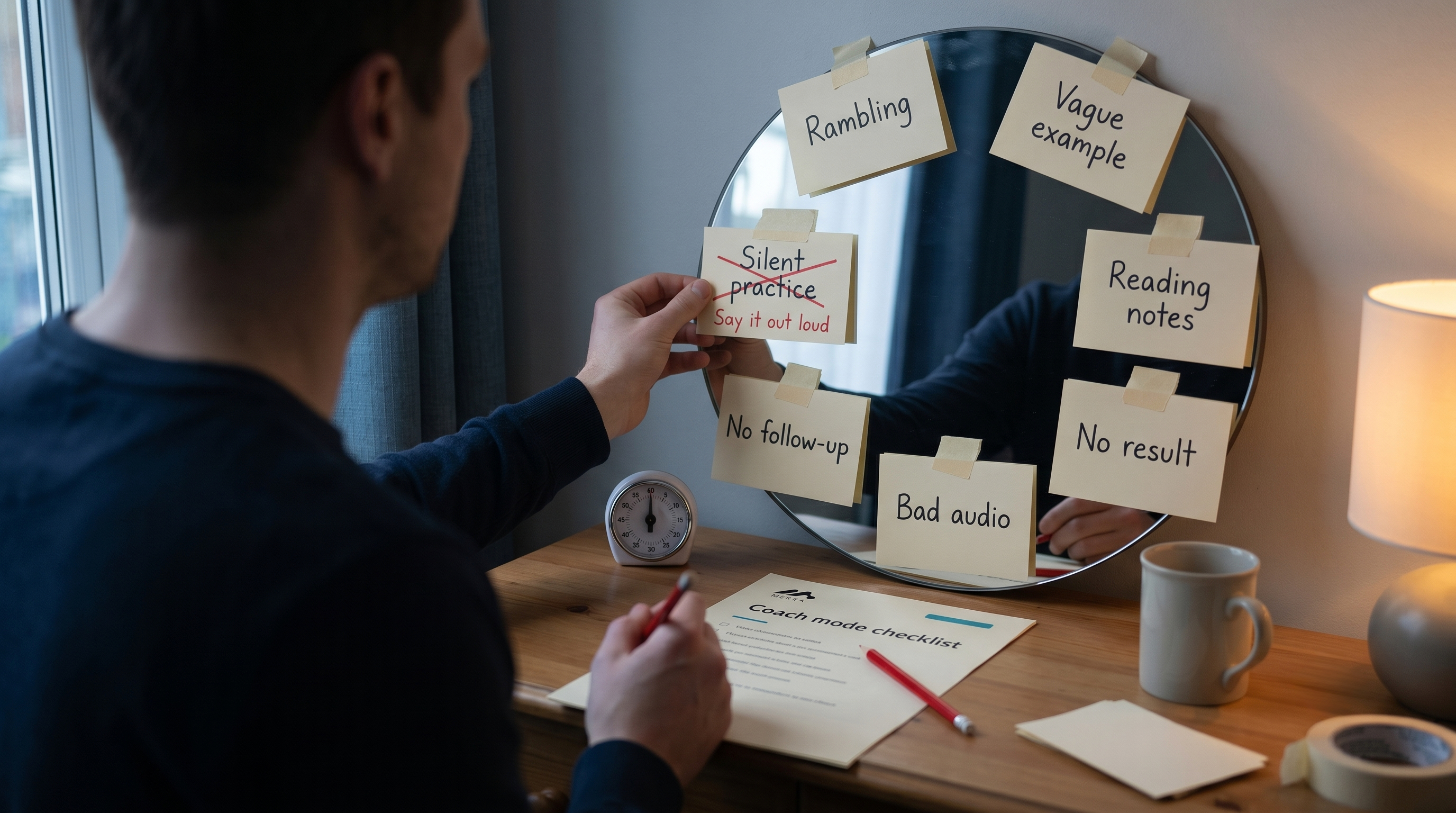
Reading three worked examples isn't practice. STAR only works once you've said your own answers out loud, against a real interview that pushes back when an answer is thin.
The free practice loop:
Pick a behavioural question. One of the 10 common ones is fine.
Write your STAR answer down using the 10-20-60-10 guideline. Keep the Situation tight, push most of the words into Action.
Open Merra Practice. Free, no signup wall. Pick Custom Interview if you've got a real role lined up, or Graduate / Early Careers if you don't.
When Merra asks at the start, pick Coach mode. Coach mode gives you feedback on each answer in real time and lets you tighten the structure before moving on. This is where you build the answers.
Run the same session again in Interview mode. Straight questions, real follow-ups, no resets. This is where you find out which of your STAR answers actually hold up under follow-up pressure.
The wider plan, including how to build a 6-story bank that covers most behavioural questions, is in How to Prepare for an AI Interview. The free practice plan more broadly is in AI Interview Practice Free.
Quick-reference STAR scaffold
For your notebook, before any AI interview:
S - Situation (10%, ≈12s): one sentence of context.
T - Task (20%, ≈24s): what I was specifically responsible for.
A - Action (60%, ≈70s): what I did. Verbs starting with I. The longest part by far.
R - Result (10%, ≈12s): measurable where possible. Specific durable change if not.
Run the practice
🎯 Run a free AI practice interview on Merra Practice and get feedback before the real one counts.
Ahmed Ghelle is the founder of Merra, an AI interviewing platform that runs structured first-round interviews on every applicant and produces a recording, transcript, and scored evaluation for each one. He writes about hiring, evidence, and the difference between speed and signal.